What Records Must an Irish Company Keep? Books of Account Explained
Every Irish company must keep adequate accounting records under the Companies Act. Learn what books of account means in practice and how long to keep records.
- Author
- Abbey Blue Formations
- Published
- Reading time
- 6 min read
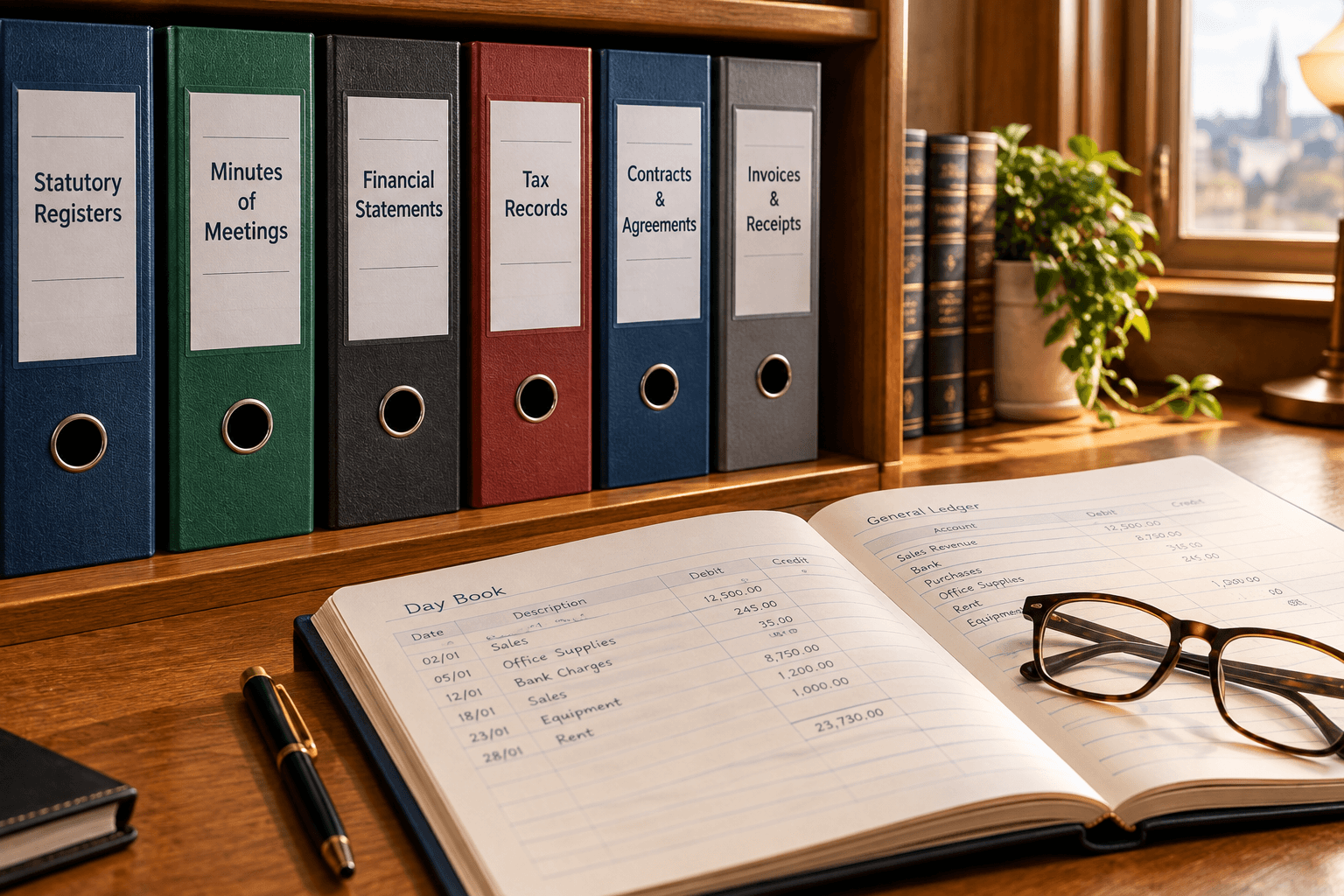
Ask most new directors what the Companies Act requires of them and they will name the Annual Return. Far fewer can name the duty that applies every single day: the obligation to keep adequate accounting records — the books of account — from the company's first transaction onward. It is a statutory duty of the directors personally, failure is an offence, and in serious cases it is one of the routes by which limited liability stops protecting the people behind the company. This guide explains what the duty actually demands, in plain English.
What "adequate accounting records" means
The Companies Act does not prescribe software or formats. It prescribes outcomes: the company's records must correctly record and explain its transactions, enable its financial position to be determined with reasonable accuracy at any time, and enable the directors to ensure the statutory financial statements can be prepared and audited. In practical terms, adequate company accounting records include:
- A record of all money received and spent, day by day, and what each item related to
- A record of assets and liabilities — what the company owns and owes
- Records of stock, including stocktakes supporting the year-end figures, where the company deals in goods
- Records of goods and services bought and sold, detailed enough to identify sellers, buyers, and invoices
- The supporting documents behind all of it: invoices issued and received, receipts, bank statements, contracts, payroll records, and expense claims
The phrase "at any time" is the test that catches people. Records assembled once a year, in a scramble before the accountant's deadline, do not meet a standard built around continuous accuracy — which is why this duty is, in substance, a bookkeeping obligation.
Where the records must be kept, and for how long
Records may be kept in physical or electronic form, and must be available at the registered office or another notified location within the State, or accessible from it where kept abroad. Retention is long: accounting records must generally be kept for six years after the end of the financial year they relate to — and tax law imposes its own six-year retention across VAT, payroll, and corporation tax records. When founders switch structures, the obligation follows the records: a director who moved from sole trader to a company keeps both eras' records for their respective periods.
Why the duty has teeth
Three consequences give this obligation its weight. First, it is an offence — and among the duties for which directors are personally answerable. Second, on insolvency, a failure to keep adequate records that contributes to the company's inability to pay its debts is one of the classic grounds on which directors face personal exposure. Third, and most practically: every other compliance obligation is downstream of the books. The financial statements behind your Annual Return, the figures in your CT1, your VAT returns, and your claim to audit exemption all stand on the same foundation. Weak books do not cause one problem; they cause all of them at once.
What good looks like month to month
A small company meets the standard comfortably with a simple, consistent rhythm:
- 1Capture everything as it happens — sales invoices numbered and issued from the company, purchase invoices and receipts filed, no gaps.
- 2Reconcile the bank monthly. Every line on the statement explained, including — especially — money moving to and from the directors, as covered in our guide to paying yourself from the company.
- 3Keep payroll, VAT, and expense records in step with each Revenue submission.
- 4Close each month so that "the financial position at any time" is a report away, not an archaeology project.
That rhythm is exactly what our bookkeeping packages provide: the books maintained monthly to the statutory standard, feeding cleanly into every filing the company faces. If your records are currently a folder of receipts and good intentions, request a call and we will put a system under them.
Frequently asked questions
My company is tiny and barely trading — does this still apply?
Yes. The duty applies to every company from incorporation, regardless of size or activity. A dormant or small company's records are simpler, but the obligation to keep them, continuously and accurately, is the same.
Can I keep everything digitally?
Yes. Electronic records are fully acceptable provided they are complete, legible, accessible from the State, and retained for the required period. Scanned invoices and cloud bookkeeping meet the standard; a shoebox meets it less reliably.
Who is legally responsible — the company, the bookkeeper, or me?
The directors. You can and should delegate the work, but the statutory duty to ensure adequate records are kept sits with the board and cannot be outsourced.
How long must records be kept after a company closes?
The retention periods survive the company's trading life, and directors winding a company up — including through voluntary strike-off — should arrange for the records to remain available for the remainder of their retention period.
What is the difference between books of account and financial statements?
The books are the continuous, detailed record of transactions; the financial statements are the annual summary prepared from them. You cannot produce honest statements from inadequate books — which is the whole logic of the statutory duty.
The bottom line
Books of account are not paperwork the accountant invents at year end: they are a daily statutory duty of the directors, with a six-year memory and real consequences. Keep them monthly, reconcile them honestly, and every deadline the company faces becomes an output of a working system rather than an annual emergency.