Your Company Is Formed — Now What? The First-Year Compliance Calendar
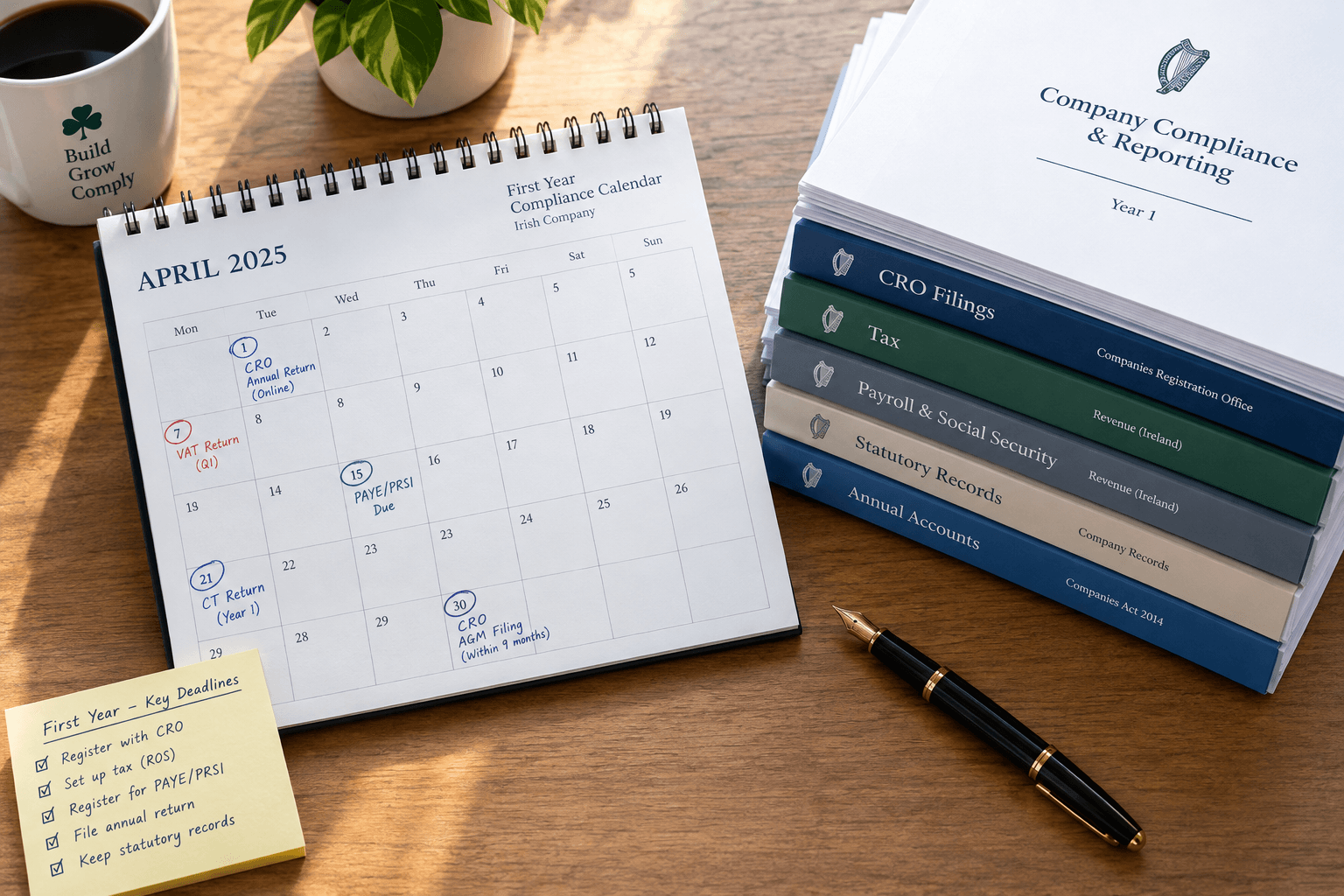
Your company is formed — now what? Follow the first-year compliance calendar for Irish companies: RBO, B1, tax registrations, VAT and corporation tax, in order.
Read insightInsights

Practical guides on company formation, compliance, CRO filings, registered office requirements, VAT, and business setup in Ireland.

Your company is formed — now what? Follow the first-year compliance calendar for Irish companies: RBO, B1, tax registrations, VAT and corporation tax, in order.
Read insight

How long does company formation take in Ireland? Realistic timelines for name approval, CRO processing, director identity checks, and what causes delays.
Read insight
Salary, dividends or expenses? Learn how paying yourself from a limited company in Ireland works, how each route is taxed, and the mistakes directors make.
Read insight
Ready to switch from sole trader to a limited company in Ireland? Learn the migration steps: forming the company, VAT, business name, contracts and payroll.
Read insight
Every Irish company must keep adequate accounting records under the Companies Act. Learn what books of account means in practice and how long to keep records.
Read insight
Setting up as a contractor in Ireland? Learn how to form your own limited company, the registrations you need, and how contractors pay themselves compliantly.
Read insight
Filing your first VAT return in Ireland? Learn how the VAT3 works, what the annual RTD is, key deadlines, and the mistakes new companies make most often.
Read insight
Need to change directors in an Irish company? Learn the B10 filing, consents, the sole-director and EEA-resident rules, and the traps that catch companies out.
Read insight
DIY bookkeeping vs outsourcing for a small Irish company — compare the real costs: your hours, software, error risk, and deadlines, against a monthly package.
Read insight
Starting a company 50/50 with a co-founder in Ireland? Learn why equal splits cause deadlock, and the mechanisms — golden share, agreements — that prevent it.
Read insight
Sole trader or limited company in Ireland? See how we helped a Wexford coffee shop form Café Con Leche Limited — and why an LTD works even for small business.
Read insight
Revenue has confirmed phased mandatory B2B e-invoicing from November 2028. What changes, who is affected first, and why every Irish business is in scope from day one.
Read insight
What documents you need, why applications get delayed, and the real difference between a licensed bank and an e-money provider for your Irish company.
Read insight
Two distinct Irish start-up reliefs — Section 486C reduces your company's corporation tax for five years; SURE refunds income tax you already paid. How each works.
Read insight
Your CT1 is due nine months after year end — but preliminary tax is due before the year even closes. The Irish corporation tax deadline calendar, explained.
Read insight
Small and micro companies can skip a statutory audit — but only if they qualify and file on time. The current size thresholds, the two-strike rule, and how exemption is lost.
Read insight
The eight fiduciary duties codified in section 228 of the Companies Act 2014, the duty to creditors on insolvency, and when limited liability stops protecting a director.
Read insight
A plain-English comparison of Irish company types — LTD, DAC, CLG, PLC — and the branch versus subsidiary decision for overseas businesses entering Ireland.
Read insight
Struck off the CRO register? Learn the difference between administrative restoration on Form H1 within 12 months and High Court restoration within 20 years.
Read insight
Every director of an Irish company must supply a PPSN or IPN to the CRO. Here is what each one is, how to get an IPN using Form VIF, and the April 2026 witnessing change.
Read insight
Not sure which formation route, documents or registrations you need? Our free company formation calculator maps out your Irish company setup step by step.
Read insight
A plain-English guide to voluntary strike-off in Ireland — the €150 asset and liability test, the Revenue letter of no objection, Form H15, the newspaper notice and timelines.
Read insight
Every new Irish company must file beneficial ownership details with the RBO within five months of incorporation. Learn who counts, what to submit, and the penalties for missing it.
Read insight
Registering a business name is not the same as registering a company. Learn what each gives you, what it costs at the CRO, and which one your business actually needs.
Read insight
A practical guide for non-resident founders who want to register an Irish company, including the EEA-resident director rule, Section 137 Bond, setup options, compliance steps and typical costs.
Read insight
A golden share can preserve control over specific company decisions while founders bring in investors or share ownership.
Read insight
Every company registered in Ireland must have a company secretary. This guide explains the role, the sole-director rule and the core duties.
Read insight
When is your Irish annual return (B1) due, how do you file it, and what happens if you’re late? A plain-English guide to CRO deadlines and penalties in 2026.
Read insight
The CRO rejects company names every day. Learn the distinctiveness rules and the checks to make before filing your Irish company name.
Read insight
The upfront formation fee is only part of the cost of setting up an Irish company. Here is the full picture, including ongoing compliance costs.
Read insight
VAT registration is driven by turnover, not by whether you are a sole trader or a company. Learn the 2026 thresholds, timing and registration process.
Read insight
A straightforward Irish company can be incorporated in a few working days. This guide explains what the CRO expects and what you need, in order.
Read insight

Registered office, virtual office and business address are not interchangeable. Learn which is legally required and when the others help.
Read insight

Should you register as a sole trader or set up a limited company? The answer depends on liability, tax, credibility and administration.
Read insight

A shelf company is already incorporated, has never traded and is ready to transfer. Learn when buying one still makes sense in Ireland.
Read insight