Civil Service Mileage and Subsistence Rates: Claiming Tax-Free Travel
Civil service mileage rates and subsistence rates explained: current bands, how company directors claim tax-free travel, and the records Revenue expects.
- Author
- Abbey Blue Formations
- Published
- Reading time
- 7 min read
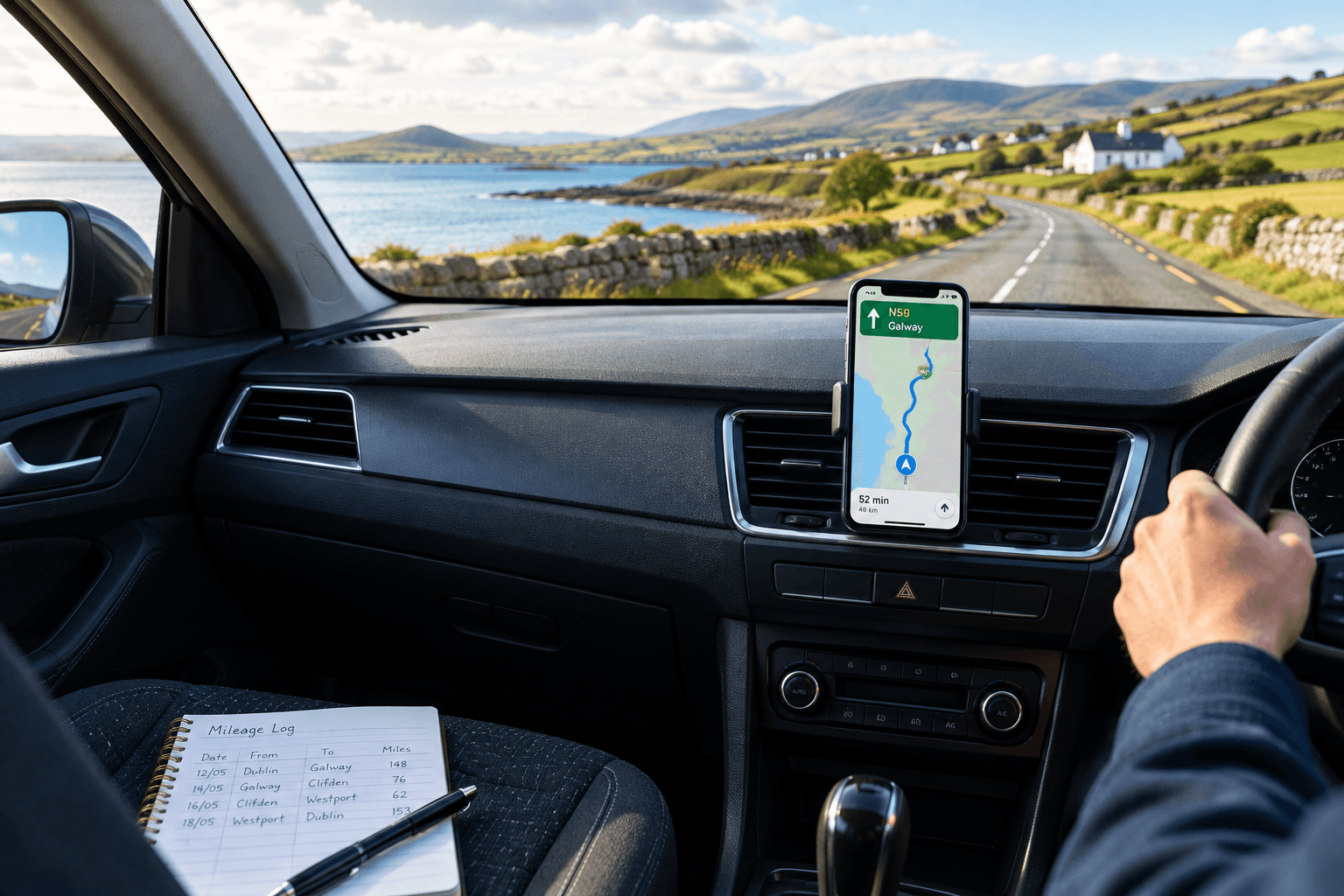
If you use your own car for company business, your company can reimburse you tax-free. The same goes for meals and overnight stays when work takes you away from your normal place of work. The benchmark for how much can be paid without tax is the civil service mileage rates and subsistence rates, which Revenue accepts for private-sector employers too.
For directors, this is one of the most useful and most misunderstood ways to take money out of a company. This guide covers the current rates, who can claim, what counts as a business journey and the records you need.
Who can claim tax-free travel and subsistence?
Employees and directors can both be reimbursed for business travel and subsistence. That includes the director of a one-person company who is on the payroll.
Your company can:
- Pay the civil service rates;
- Pay lower rates; or
- Reimburse actual, vouched costs backed by receipts.
Rates higher than the civil service rates must be approved by Revenue in advance. Otherwise, the excess is treated as taxable pay.
If you are weighing up how to draw income from your company, our guide to paying yourself from a limited company explains how expenses fit alongside salary and dividends.
Current civil service mileage rates
The motor travel rates for cars (effective from 1 September 2022, reissued unchanged in 2025) depend on engine size and the total business kilometres travelled in the year:
| Business km in the year | Up to 1,200cc | 1,201–1,500cc | 1,501cc and over |
|---|---|---|---|
| Up to 1,500 km | 41.80c | 43.40c | 51.82c |
| 1,501–5,500 km | 72.64c | 79.18c | 90.63c |
| 5,501–25,000 km | 31.78c | 31.79c | 39.22c |
| Over 25,000 km | 20.56c | 23.85c | 25.87c |
These are the Revenue mileage rates most Irish employers use as their ceiling. Separate, lower rates apply to motorcycles, and bicycles are paid at 8c per km.
Worked example
A director drives a 1,600cc car and does 3,000 business kilometres in the year:
- First 1,500 km at 51.82c = €777.30
- Next 1,500 km at 90.63c = €1,359.45
- Total tax-free mileage allowance Ireland claim: €2,136.75
Because the bands are cumulative, the rate per kilometre changes as the year goes on.
Current subsistence rates Ireland
Domestic subsistence rates Ireland employers can pay tax-free (effective from 29 January 2025) are:
Overnight allowance
- Normal rate: €205.53
- Reduced rate: €184.98
- Detention rate: €102.76
The reduced and detention rates apply to longer stays in the same place.
Day allowance
- 10 hours or more away: €46.17
- 5 to 10 hours away: €19.25
What counts as a business journey?
This is where most claims go wrong. Revenue defines business travel as travel from one place of work to another as part of your duties.
Commuting is never a business journey. Driving from home to your normal place of work, and back, is private travel, even for a director.
Your normal place of work is where you work day to day. Home generally does not count as your normal place of work unless there is an objective requirement for the duties to be done there. Simply choosing to work from home, or doing minor admin there, does not qualify.
Starting from home. If you drive from home to a temporary workplace, such as a client's site, you can claim the lower of the distance from home to the temporary workplace or the distance from your normal place of work to it.
Records Revenue expects you to keep
Tax-free means tax-free only if you can prove it. For every reimbursement, the company should record:
- The name and address of the director or employee
- The date of the journey
- The reason for the journey
- The kilometres travelled
- The starting point, destination and finishing point
- The basis of the expense (for example, an overnight stay)
- Receipts, where actual costs are reimbursed
Records must be kept for six years after the end of the tax year they relate to.
Employers must also report travel and subsistence payments to Revenue through ROS on or before the date of payment, under the Enhanced Reporting Requirements. This applies to directors as well as employees.
A simple monthly mileage log, reviewed as part of your bookkeeping, makes this manageable. Our guide to company records and books of account covers what else to keep, and our fully online bookkeeping and accounting packages include processing expense claims and keeping the supporting records in order.
Common mistakes to avoid
- Claiming the daily commute because "the company is based at home".
- Paying a round-figure monthly "car allowance" with no log. That is taxable pay.
- Claiming subsistence for a short trip down the road.
- Forgetting to report payments to Revenue before paying them.
Contractors are especially exposed here, as they often work on one client site for long periods. Our guide to running a contractor limited company looks at when a client site becomes your normal place of work.
Frequently Asked Questions
What are the civil service mileage rates for cars?
The civil service mileage rates for cars range from 20.56c to 90.63c per kilometre, depending on engine size and the total business kilometres in the year. For example, a car over 1,500cc is paid 51.82c for the first 1,500 km and 90.63c from 1,501 to 5,500 km. The rates in force since 1 September 2022 were reissued unchanged in 2025.
Can a company director claim mileage tax-free?
Yes. Directors can be reimbursed tax-free for genuine business journeys at or below the civil service rates, provided the company keeps proper records and reports the payments to Revenue on or before payment. Commuting between home and your normal place of work does not qualify, even if you own the company.
Are Revenue mileage rates the same as civil service rates?
In practice, yes. The Revenue mileage rates accepted for tax-free payments are the civil service rates. Employers can pay less, or reimburse vouched actual costs, but paying more than the civil service rates requires Revenue's prior approval. Otherwise, the excess is treated as taxable pay.
What are the day subsistence rates in Ireland?
The domestic day subsistence rates Ireland uses are €46.17 for absences of 10 hours or more and €19.25 for 5 to 10 hours, effective from 29 January 2025. The normal overnight rate is €205.53. The absence must be due to business travel away from your normal place of work.
Do I need receipts for a mileage allowance?
For a mileage allowance Ireland claim at civil service rates, you do not need fuel receipts, but you must record the date, reason, kilometres, starting point, destination and finishing point of each journey. Keep these records for six years after the end of the tax year. Receipts are needed if actual costs are reimbursed instead.
Keep your expenses clean from the start
Tax-free expenses work best when they are logged monthly and built into your bookkeeping from day one. We set up companies and look after their books, so claims are paid correctly and reported on time. Click here to use our free Formation Calculator to see what forming your company will cost, or contact our team with your questions.