Your First VAT Return: VAT3, the RTD, and the Mistakes New Companies Make
Filing your first VAT return in Ireland? Learn how the VAT3 works, what the annual RTD is, key deadlines, and the mistakes new companies make most often.
- Author
- Abbey Blue Formations
- Published
- Reading time
- 6 min read
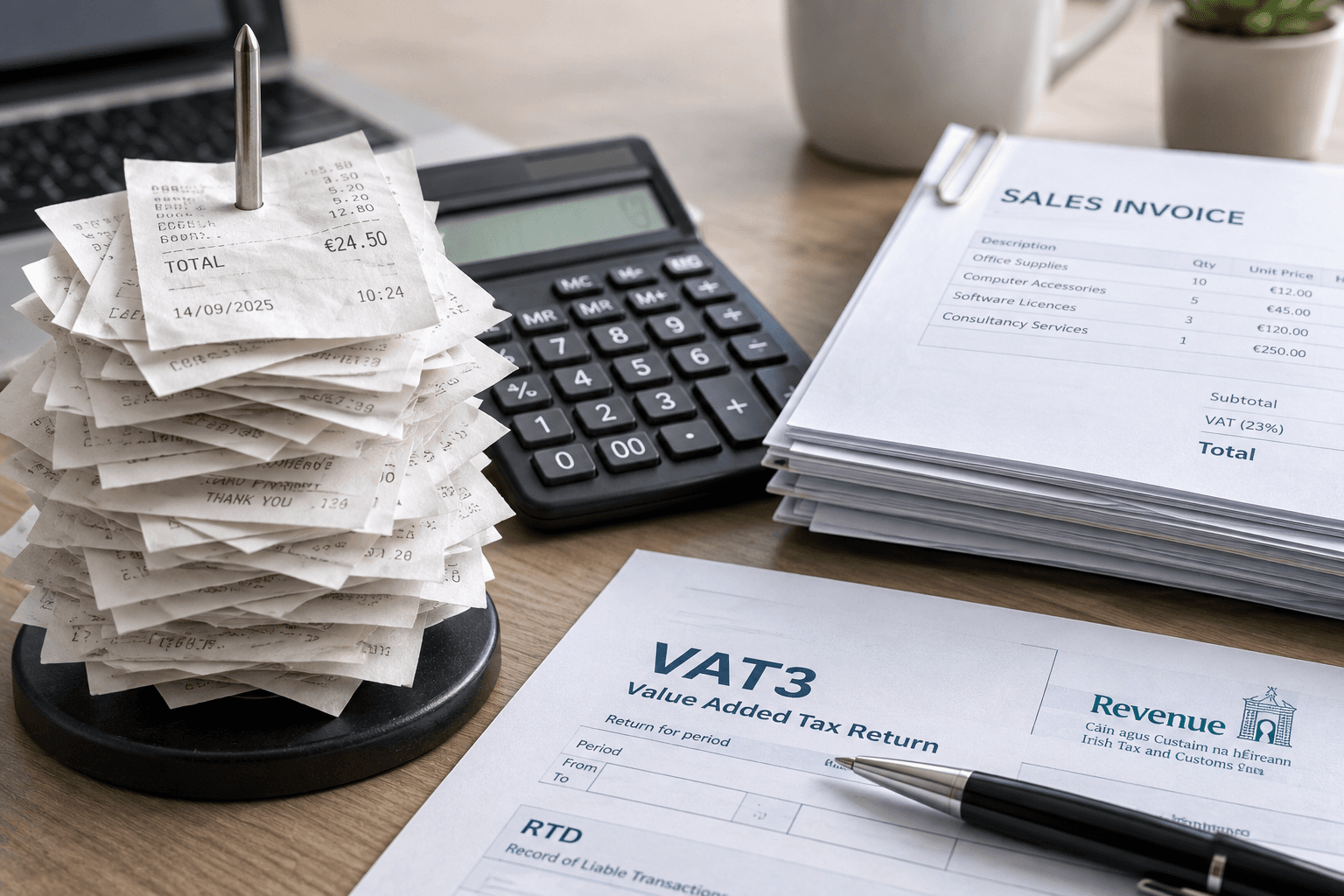
Registering for VAT is a milestone; the obligations begin immediately afterwards. From your effective date of registration, your company is a VAT collector for the State, and the first VAT return — the VAT3 — is where new businesses discover whether their records are as good as they assumed. This guide explains the return itself, the annual Return of Trading Details (RTD) that surprises almost everyone, and the errors that generate most Revenue correspondence in year one.
The VAT3: what it is and when it's due
The VAT3 is the periodic return summarising the VAT story of each taxable period. The default period is two months — January/February, March/April, and so on — with the return and payment due by the 19th of the following month, extended to the 23rd for those filing and paying through ROS. Smaller traders may be offered less frequent filing over time, but new registrations should plan around the bi-monthly rhythm.
The return itself is deceptively short. Its core boxes are:
- T1 — VAT on sales: the output VAT you charged in the period
- T2 — VAT on purchases: the deductible input VAT you incurred
- T3 or T4 — the balance: payable to Revenue where T1 exceeds T2, repayable to you where the reverse
- E1/E2 and ES1/ES2: the value of goods and services traded with other EU states, which most first-time filers skip incorrectly
A "short" return, in other words, that summarises every transaction in the period — which is why the real work of the VAT3 happens in the books, not on the form.
The RTD: the return nobody warned you about
Once a year, aligned to your accounting period, Revenue expects the Return of Trading Details — a statistical breakdown of the year's sales and purchases across the VAT rates. The RTD carries no payment, which leads new companies to ignore it; Revenue does not. An outstanding RTD blocks tax clearance and can hold up VAT repayments, quietly, until someone works out why. Diarise it with the year-end pack, and treat it as the annual reconciliation it effectively is: if the RTD's totals do not tie back to your six VAT3s and your accounts, something in the year needs explaining.
The first-return mistakes that cause most trouble
- 1Claiming input VAT without valid invoices. Deduction requires a proper VAT invoice in the company's name — not a card receipt, not an order confirmation. Set the standard on day one.
- 2Claiming the blocked categories. VAT on passenger cars, petrol, food, drink, and entertainment is generally not deductible regardless of business purpose. These appear on almost every incorrect first return.
- 3Ignoring the reverse charge. Services bought from abroad — software subscriptions are the classic — must be self-accounted for on the return. The EU boxes exist for a reason.
- 4Pre-registration VAT handled wrongly. Some VAT incurred before registration is recoverable within limits; claiming everything, or nothing, are both errors.
- 5Timing confusion. Returns follow your basis of accounting — invoice basis by default, cash receipts basis where elected and eligible — and mixing the two across periods produces the discrepancies Revenue queries.
- 6Missing the deadline because the books weren't ready. The most common failure has nothing to do with VAT law: the period closed, the records weren't, and the 23rd arrived anyway.
The system that makes VAT routine
Every item above traces back to the same root: the VAT return is an output of your bookkeeping, filed six times a year, reconciled once by the RTD. A monthly rhythm — invoices captured with correct VAT treatment, bank reconciled, the period reviewed before filing — turns the VAT3 into a fifteen-minute confirmation. That rhythm is what our bookkeeping packages provide, with the VAT3s and RTD prepared from books that already balance, and it sits inside the wider record-keeping duty every company carries.
If you have not yet registered, start with our guide to VAT registration thresholds and timing or let our VAT and tax registration service handle the application; if your first period has already closed and the records are a folder of PDFs, request a call and we will get the first return filed properly — and the system built so the second one is boring. For where VAT compliance is heading longer term, see our analysis of Ireland's e-invoicing mandate.
Frequently asked questions
When is my first VAT3 due?
It covers the taxable period in which your registration takes effect, and is due by the 19th of the following month — the 23rd via ROS. Your effective date of registration, not your first invoice, starts the clock.
What if I had no sales in the period?
File anyway. A nil VAT3 is still a required return, and unfiled periods accumulate into compliance problems, blocked clearance, and estimated assessments.
Can I reclaim VAT on costs from before I registered?
Within limits, yes — certain pre-registration VAT on goods on hand and setup costs can be recovered on the first return. The rules are specific, so identify eligible items deliberately rather than sweeping everything in.
What is the difference between the VAT3 and the RTD?
The VAT3 is the periodic return with a payment or repayment attached; the RTD is the annual, payment-free statistical breakdown across VAT rates. Both are mandatory, and the RTD's absence quietly blocks tax clearance and repayments.
Invoice basis or cash receipts basis — which should a new company use?
Invoice basis is the default; the cash receipts basis, available to qualifying businesses, delays output VAT until customers actually pay and can materially help cash flow. Choose deliberately at registration and apply one basis consistently.
The bottom line
Your first VAT return is a test of your records, not your form-filling. Learn the VAT3's rhythm, respect the blocked deductions and the reverse charge, never skip a nil return, and file the RTD before it blocks something that matters. Companies that treat VAT as a monthly bookkeeping output — rather than a bi-monthly emergency — stop noticing the deadlines at all.