DIY Bookkeeping vs Outsourcing: The Real Cost for a Small Irish Company
DIY bookkeeping vs outsourcing for a small Irish company — compare the real costs: your hours, software, error risk, and deadlines, against a monthly package.
- Author
- Abbey Blue Formations
- Published
- Reading time
- 6 min read
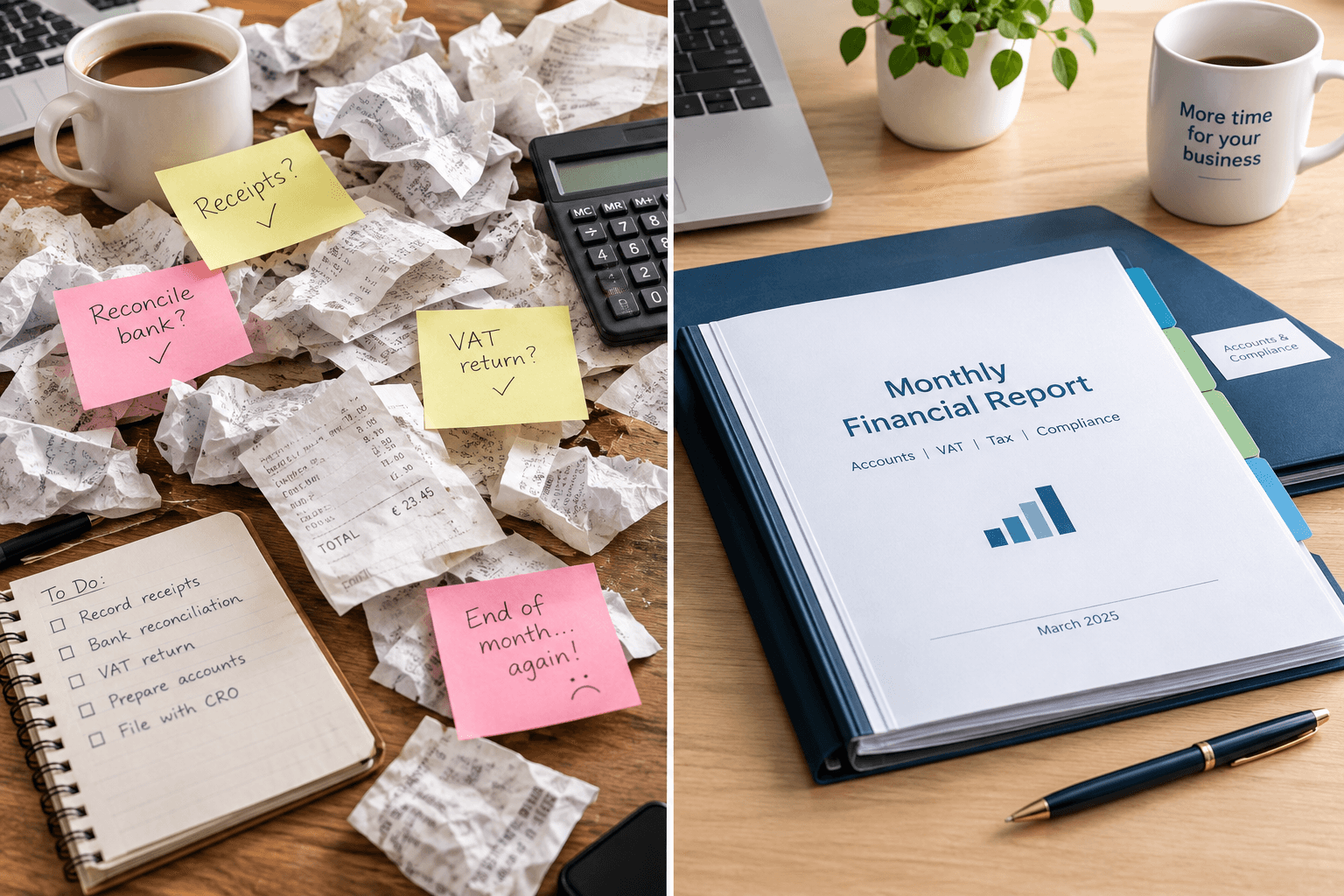
Every founder does the same mental arithmetic: a bookkeeping subscription costs money every month, and doing it yourself costs nothing. The arithmetic is wrong on both sides. DIY bookkeeping has a real cost — paid in your hours, your error rate, and your deadlines — and outsourced bookkeeping buys more than data entry. This guide prices the comparison honestly, because for some companies DIY genuinely is the right answer, and for most trading companies it stops being one earlier than founders expect.
What the books actually require — whoever does them
The workload is fixed by law and by Revenue's calendar, not by your preference. Every Irish company must keep adequate accounting records continuously; a VAT-registered company files a VAT3 every two months and an annual RTD; an employer — including a director on payroll — reports in real time every payday; and the year-end accounts behind the Annual Return and CT1 are built from whatever the books contain. The only variable is who does the work, and how well.
The true cost of DIY
Price the do-it-yourself route the way you would price any supplier:
- Your hours, at your value. A modest trading company generates three to eight hours of proper bookkeeping a month — capture, categorisation, bank reconciliation, VAT review, payroll. At any realistic value for a founder's selling or billable time, that is hundreds of euro a month before anything goes wrong.
- Software and learning curve. Cloud bookkeeping tools carry their own subscriptions, and the software automates entry, not judgement: it will happily reclaim VAT on a car lease or misclassify a director's transfer if you tell it to.
- The error premium. The common DIY failures — blocked VAT deductions claimed, the reverse charge missed, an unreconciled director's loan, a late nil return — surface months later as Revenue interest, corrections, and an accountant's bill for untangling that dwarfs the bookkeeping fee that would have prevented it.
- The deadline tax. DIY books are done "when there's time," and there is never time in a good month. Late periods compound: a company behind on its books is behind on every filing downstream, and a late B1 alone costs two years of audit exemption.
- The blindfold cost. The subtlest expense: books that are three months stale mean pricing, hiring, and tax decisions made on guesswork. You cannot manage margins you cannot see.
What outsourcing actually buys
A monthly bookkeeping package is priced as a fee, but what it delivers is a system: transactions captured and categorised correctly, the bank reconciled every month, VAT returns prepared from books that already balance, payroll run on time, the director's loan watched, and a monthly position you can read — with year end reduced to a handover rather than an excavation. The fee substitutes for your hours at a rate below what those hours are worth, and it removes the error premium and deadline tax almost entirely. It also scales: the package flexes as invoices, staff, and VAT complexity grow, where DIY effort grows linearly with every transaction.
The honest decision framework
DIY is defensible when all of the following hold: transaction volume is genuinely low, you are not yet VAT-registered, there is no payroll beyond a simple director's salary, and you will actually sit down with the books every month — not quarterly, monthly. The moment any leg fails — VAT registration lands, a first employee arrives, invoices multiply, or two months pass unreconciled — the DIY price has silently overtaken the package fee. New companies at formation face the choice at the best possible moment: starting on a professional footing from month one, as part of the first-year compliance calendar, costs less than converting a year of DIY records later.
If you want the comparison priced for your actual company — your volumes, VAT position, and payroll — request a call and we will quote the package against an honest estimate of your DIY hours. One of the two numbers will be clearly smaller.
Frequently asked questions
Is bookkeeping software enough on its own?
Software is a tool, not a bookkeeper: it speeds up capture and reconciliation but applies whatever treatment you choose, correct or not. The judgement layer — VAT treatment, categorisation, the director's loan — is where DIY errors live, with or without good software.
What does outsourced bookkeeping typically cost for a small Irish company?
Packages scale with transaction volume, VAT status, and payroll, which is why honest providers quote from your actual profile rather than a flat rate. Our bookkeeping packages set out the tiers, and a call prices your specific company.
Can I do the books myself and just hand everything over at year end?
You can, and year end is where that plan gets expensive: accounts prepared from twelve months of uncorrected records cost more in accountancy time than monthly bookkeeping would have, and any errors have been compounding through six VAT returns.
If I outsource, am I still responsible?
Yes. The statutory duty to keep adequate records sits with the directors and cannot be delegated away — outsourcing changes who does the work and how well, not who answers for it.
When is the right time to switch from DIY?
At the earliest trigger: VAT registration, first employee, rising volume, or the first month you fall behind. Companies that switch at the trigger convert cleanly; companies that switch at the crisis pay for the crisis first.
The bottom line
The DIY bookkeeping vs outsourcing question is a cost comparison in which one side hides its price. Count your hours at their real value, add the error premium and the deadline tax, and weigh that against a monthly fee that delivers reconciled books and met deadlines. For a genuinely tiny, disciplined company, DIY can win; for a trading company with VAT and payroll, it almost never does for long.