Invoice Requirements in Ireland: What Must Be on a VAT Invoice
Build a compliant invoice template in Ireland: what must be on a VAT invoice, credit note rules, the 15-day deadline and what e-invoicing changes.
- Author
- Abbey Blue Formations
- Published
- Reading time
- 7 min read
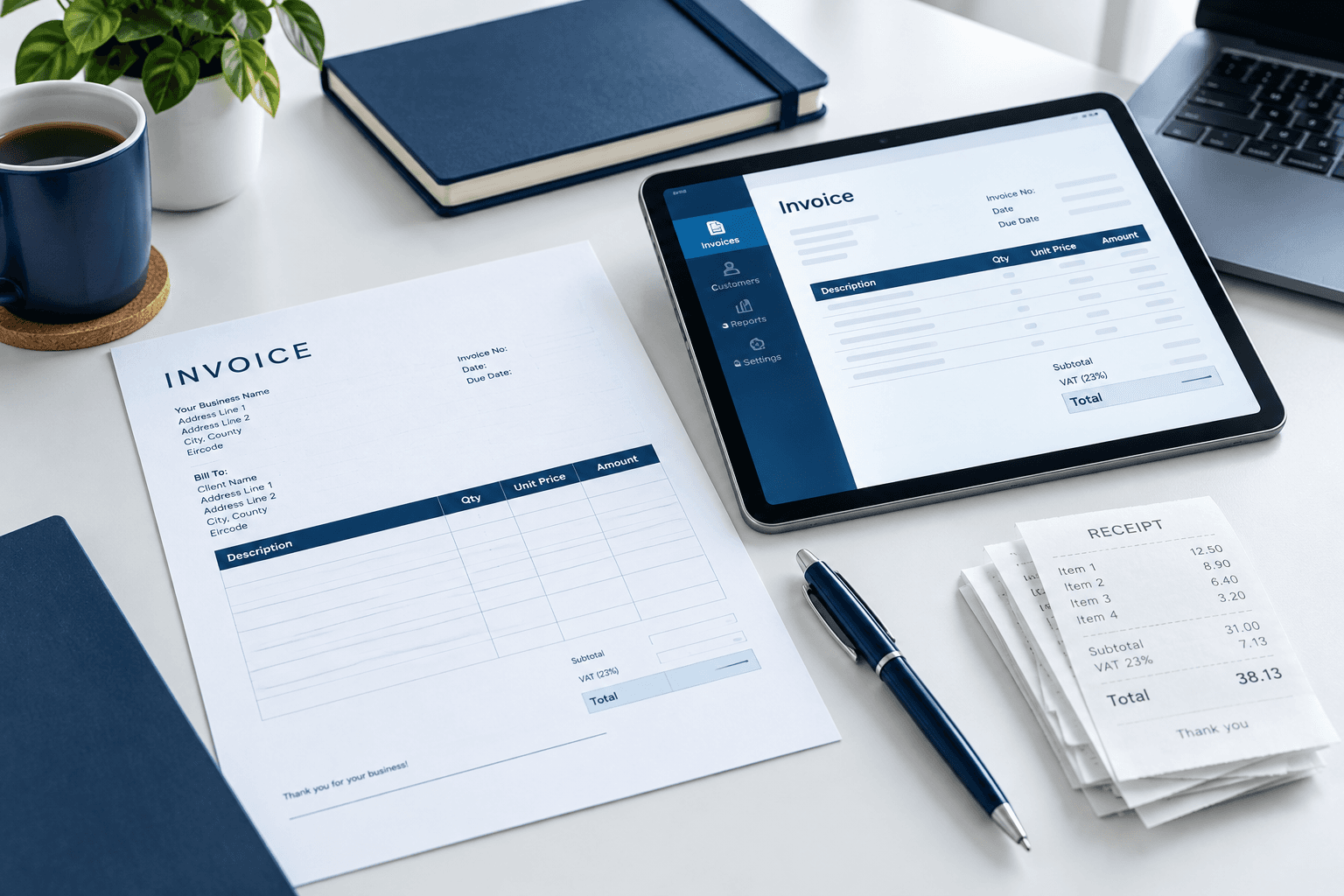
A tidy invoice template Ireland businesses can reuse saves time, but only if it contains everything Revenue expects. Miss a required detail and your customer may not be able to reclaim the VAT, which is a quick way to delay payment.
This guide sets out the invoice requirements Ireland VAT-registered businesses must meet, when you must issue an invoice or credit note, how long to keep records and what e-invoicing will change.
When you must issue a VAT invoice
If you are registered for VAT, you must issue a VAT invoice when you supply goods or services to:
- another VAT-registered business
- a government department, local authority or statutory body
- a person carrying on exempt activities
- a business (other than an individual) in another EU member state
- a customer where reverse charge VAT applies
You do not need to issue a VAT invoice for sales to private consumers, though many businesses provide a receipt anyway. Special rules apply in construction, where Relevant Contracts Tax can change who accounts for VAT.
Timing: a VAT invoice must be issued within 15 days of the end of the month in which the goods or services were supplied. For example, work completed on 10 March must be invoiced by 15 April.
Not registered yet? Our guide to VAT registration in Ireland explains the thresholds and process.
What must be on a VAT invoice in Ireland
A full VAT invoice Ireland Revenue will accept must show:
- the date of issue
- a unique sequential invoice number
- your full name, address and VAT registration number
- your customer's full name and address
- a description of the goods (quantity and nature) or services (extent and nature)
- the date the goods or services were supplied
- the unit price excluding VAT
- any discounts or price reductions
- the breakdown by VAT rate
- the total VAT payable
Some items apply only in certain situations:
Reverse charge: the customer's VAT number and the words "reverse charge applies".
Intra-Community supply of goods: the customer's VAT number and a note that it is an intra-Community supply.
Advance payments: the date of payment, where it differs from the invoice date, and the payment received net of VAT.
Foreign currency: corresponding figures in euro, normally using the Central Bank selling rate at the time of issue.
Simplified invoices
Where the invoice amount is €100 or less, you can issue a simplified invoice. It must still show the date, your name, address and VAT number, a description of the supply, and the VAT payable or the price excluding VAT. Simplified invoices cannot be used for intra-Community supplies.
Company details on business documents
Companies must also show certain details on business letters and order forms, including the full company name, place of registration, registered number and registered office. Adding these to your invoice template Ireland layout is a simple way to stay consistent across your paperwork.
Credit notes: when and what to include
You must issue a VAT credit note when the original price changes because of a discount, allowance or similar adjustment, or when the VAT rate on the original invoice was wrong. The same 15-day deadline applies. A credit note is not needed if you reduce the price excluding VAT but the VAT payable does not change.
A credit note Ireland Revenue accepts must show:
- the date of issue and a unique number
- your full name, address and VAT number
- your customer's full name, address and VAT number
- the reason for issuing it
- a cross-reference to the original invoice
- the amended amount
- the VAT rates that applied on the original invoice and the VAT at each rate
Never delete or edit an issued invoice. Raise a credit note and, if needed, a fresh invoice.
Building an invoice template in Ireland and keeping records
You must keep all records relevant to the business, including copies of invoices and credit notes, for six years. Records may need to be kept longer if a claim, appeal or Revenue enquiry is open. Our guide to company records and books of account covers the wider rules.
When you build your template:
- lock the numbering so it runs in sequence with no gaps
- set up each VAT rate you use as a separate line option
- include payment terms and bank details
- keep a matching credit note template
Accounting software handles most of this automatically and feeds your VAT return. Our guide to the first VAT return shows how invoice data flows into the VAT3.
E-invoicing: what is changing
Today, electronic invoices are allowed where both parties agree and your system guarantees the integrity and origin of each invoice with a reliable audit trail. A PDF sent by email is widely used under current rules.
That will change. Revenue's phased plan introduces mandatory structured e-invoicing:
- November 2028: VAT-registered large corporates, for domestic business-to-business supplies, with real-time reporting.
- November 2029: all VAT-registered businesses trading business-to-business across the EU.
- July 2030: full EU-wide requirements for cross-border B2B transactions.
E-invoices must follow the European standard EN 16931, and PDFs or scanned invoices will no longer meet VAT requirements for transactions in scope. You may also need to receive e-invoices before your own phase begins. Read our guide to the Irish e-invoicing mandate to prepare.
Frequently Asked Questions
Is there an official invoice template in Ireland?
No. Revenue does not provide an official invoice template Ireland businesses must use. You can design your own, provided every VAT invoice shows the required details, such as the date, a unique sequential number, your VAT number, customer details, description, VAT-exclusive price, rate breakdown and total VAT.
Do I need to issue a VAT invoice to consumers?
No. VAT invoices are required for supplies to VAT-registered businesses, public bodies and certain other customers, but not for sales to private individuals. You can still give consumers a receipt, and many businesses do.
How long do I have to issue a VAT invoice?
A VAT invoice Ireland rules require must be issued within 15 days of the end of the month in which you supplied the goods or services. The same deadline applies to credit notes. Building invoicing into a monthly routine makes this easy to meet.
Can I just cancel an invoice instead of issuing a credit note?
Not once it has been issued to a customer. A credit note Ireland rules accept must reference the original invoice, state the reason and show the amended amount and VAT. This keeps your numbering sequence and VAT records accurate for Revenue.
Will my PDF invoices still be valid under e-invoicing?
For now, yes, where you and your customer agree to electronic invoicing. Once your business comes within the phased mandate, PDFs will not satisfy the invoice requirements Ireland VAT law sets for in-scope transactions, and you will need a structured format that meets EN 16931.
Get your invoicing and VAT right from day one
Need help registering? Our VAT and tax registration service handles it, and our online bookkeeping and accounting packages keep invoices, VAT and records in order. Starting a company? Click here to use our free Formation Calculator.