How to Check a VAT Number in Ireland and Use VIES
How to check a VAT number in Ireland or the EU on VIES, read the result, and invoice EU business customers correctly under the reverse charge.
- Author
- Abbey Blue Formations
- Published
- Reading time
- 6 min read
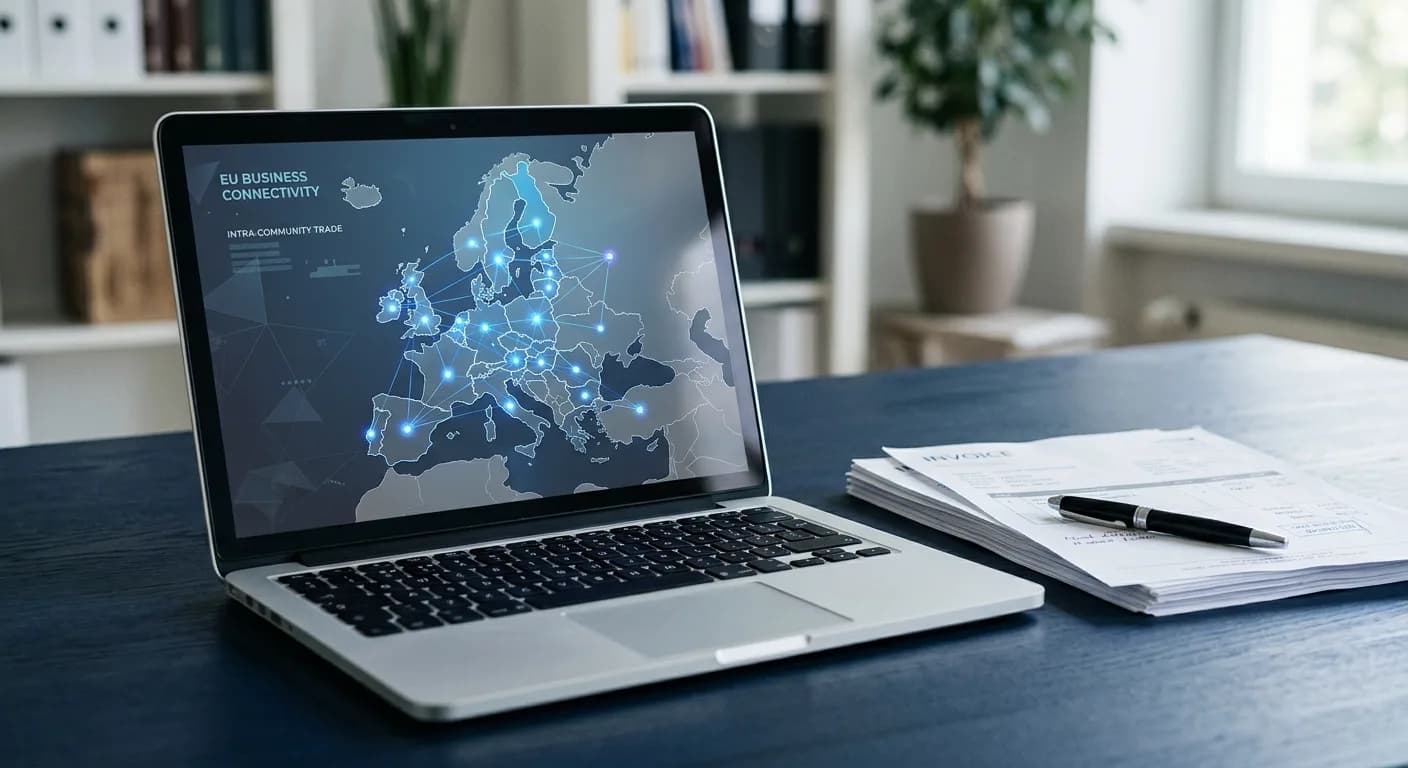
Niamh runs a small design studio in Wexford. A new client in Munich has signed off on a brand project and asked her to send the invoice "without Irish VAT, under the reverse charge". Niamh has never invoiced outside Ireland before.
The first thing she needs to do is check a VAT number in Ireland or, in this case, Germany, before the invoice goes out. That one check decides whether she can leave Irish VAT off the bill. This guide walks through it step by step, then covers the invoice wording and the return that follows.
Why you check a VAT number before invoicing
When you sell to a VAT-registered business in another EU country, you can usually leave Irish VAT off the invoice. For services, the customer accounts for VAT in their own country. For goods, the sale can be zero-rated as an intra-Community supply.
Both depend on the customer having a valid VAT number. Revenue's VIES guidance is clear: failing to hold the customer's correct EU VAT number can cancel a claim to zero-rating. If you cannot meet the conditions, you charge Irish VAT at the normal rate.
So the check is not a formality. It is your evidence.
How to check a VAT number in Ireland and the EU on VIES
VIES (the VAT Information Exchange System) is the EU's shared database of VAT registrations. A VIES check takes a minute:
- 1Open the European Commission's VIES VAT number validation tool.
- 2Choose the customer's country from the list (Germany, for Niamh).
- 3Enter the number without the country prefix.
- 4Submit and read the result: valid or invalid.
- 5Save the result page as a PDF or screenshot, with the date showing, and file it with the customer record.
Do the same check when you check a VAT number in Ireland for an Irish business, by choosing Ireland from the list.
Revenue's guidance says to verify the number, including its country prefix, before you report it. For long-standing customers you know well, written confirmation of the number can also support your records, but a dated EU VAT number check is the simplest proof to keep.
What an Irish VAT number looks like
An Irish VAT number starts with IE and is usually followed by seven digits and one or two letters, for example IE1234567A. Some older numbers follow a slightly different pattern with six digits and two letters.
Not every Irish VAT number shows on VIES. A business registered for VAT for domestic trade only will not appear as valid for cross-border use. If your own company needs to trade with EU customers, you must apply to Revenue for intra-EU registration. That also brings you into the VIES reporting described below. If you have not registered yet, start with our guide to registering for VAT, or use our tax registration service.
If the number comes back invalid
An invalid result does not always mean the customer is not registered. Common reasons include:
- A typo, or an extra space or letter
- The wrong country selected
- The prefix typed into the number field
- A registration that is domestic-only
- A new registration not yet showing
- The member state's database being temporarily unavailable
Ask the customer to confirm the number in writing and run a fresh VIES check. Until you have a valid result, treat the sale as you would a sale to an unregistered customer and charge Irish VAT. Niamh's Munich client sent a corrected number the same day, and the second check came back valid.
Invoicing EU business customers
Once the number is confirmed, the invoice wording matters. Revenue's invoice rules set out what to add, and our guide to invoice requirements covers the standard details.
Services to an EU business: Under the general rule, business-to-business services are taxed where the customer is established. The customer self-accounts for VAT in their own country. This is how reverse charge VAT in Ireland works for outgoing services. The invoice must show:
- Your VAT number and the customer's VAT number
- A note that "reverse charge applies"
- No VAT amount
Goods to an EU business: The invoice must show the customer's VAT number and state that it is an "intra-Community supply of goods". Keep proof that the goods left Ireland and arrived in the other member state, such as transport documents.
Some services, such as those connected with property in Ireland, have their own rules. If you are unsure, check before you invoice.
The VIES statement after the sale
Leaving VAT off the invoice brings a reporting duty. Every VAT-registered trader that makes these EU supplies must file a VIES statement through ROS. There is no minimum value.
The statement is due by the 23rd of the month after the period ends.
Goods: you file monthly once your EU goods sales go over €50,000 in a quarter. Below that, quarterly filing can apply.
Services: you can choose monthly or quarterly.
If you made no EU supplies in a period, you still file a nil statement.
The same sales also appear on your VAT3 return. Keeping both in line is much easier when your bookkeeping tags EU sales from the start. That is part of our accounting and bookkeeping work for clients who trade abroad.
Frequently Asked Questions
How can I check a VAT number is valid?
Run an EU VAT number check on the European Commission's VIES tool. Choose the country, enter the number without the prefix, and save the dated result with your records.
What is VIES?
VIES is the EU system that lets businesses confirm the VAT numbers of customers in other member states. It is also the name of the statement you file to report zero-rated EU sales.
Why does an Irish VAT number not show on VIES?
Usually because the business is registered for domestic trade only. It needs intra-EU registration from Revenue before it appears as valid for cross-border trade.
How do I find my company's VAT number?
It is on your VAT registration confirmation from Revenue and in your ROS account. Your accountant will also have it on file.
Do I charge Irish VAT to an EU business customer?
Usually not, if the customer gives you a valid VAT number and the general rules apply. For services, that is reverse charge VAT in Ireland in practice. Without a valid number, you charge Irish VAT.
Get your EU invoicing set up correctly
Your first EU customer is a good time to set up the process properly: the VAT number check, the invoice template and the VIES statement. Abbey Blue Formations can register your company for intra-EU VAT and handle the returns. If you are still setting up, our Formation Calculator shows what is involved. For a call back, click here.